
ERPC Adds Scheduled Cancellation to Hourly Plans — Decide Your Usage Hours Up Front and Release Resources Automatically, Making Spot Usage and Validation More Worry-Free
ERPC Adds Scheduled Cancellation to Hourly Plans — Decide Your Usage Hours Up Front and Release Resources Automatically, Making Spot Usage and Validation More Worry-Free
ELSOUL LABO B.V. (Headquarters: Amsterdam, the Netherlands; CEO: Fumitake Kawasaki) and Validators DAO, which operate ERPC, are pleased to announce that the ERPC platform has added a "Scheduled cancellation" feature to its hourly billing plans.
Scheduled cancellation lets you specify in advance how many hours from now to cancel a Solana-optimized resource launched on hourly billing — in effect, a scheduled stop you reserve up front. When the specified time arrives, the resource is released automatically at the next billing cycle. For spot usage where your intended hours are reasonably clear, or for short-term validation such as test runs and benchmarks, you can reserve exactly the hours you need and have it end automatically, without waiting to release the resource by hand.
Until now, hourly billing has been used by many customers as a contract model that lets you "try it for as little as an hour," but managing when to end usage had to be done manually. With this scheduled cancellation feature, once you decide at launch how long you'll run it, resources are then released automatically according to schedule without you having to return to the dashboard manually. You can reserve resources on a spot basis with peace of mind while helping suppress unintended long-running usage caused by forgetting to stop.
Specify How Many Hours From Now to Cancel, Up Front — How Scheduled Cancellation Works
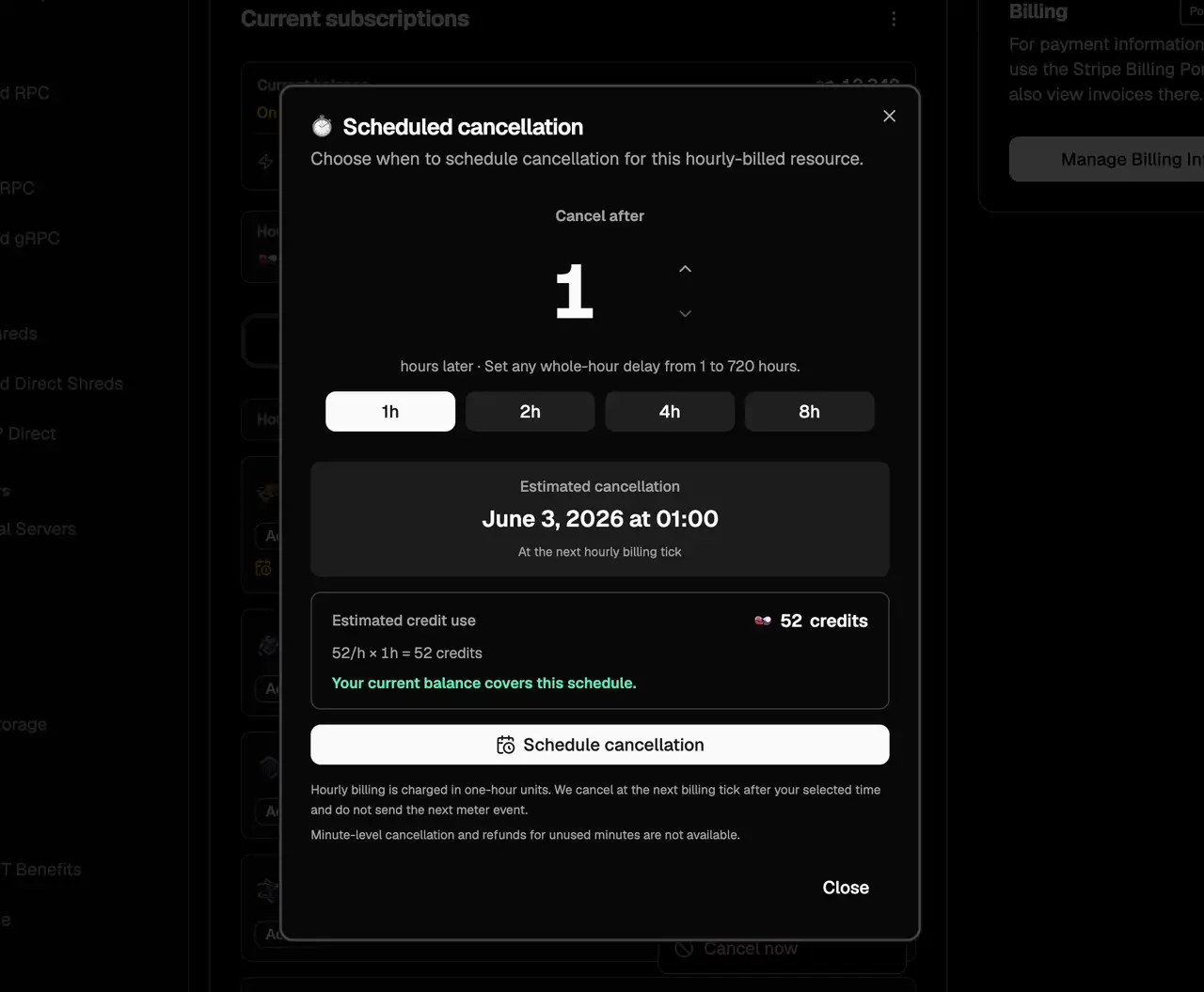
Scheduled cancellation can be set from the management screen for hourly billing resources in the ERPC Dashboard. You can specify how many hours from now to cancel within a range of 1 to 720 hours (in one-hour increments), and you can also quickly choose from 1h / 2h / 4h / 8h presets. Because you can specify up to 720 hours (30 days), it supports everything from a few hours of spot usage to setting an upper limit on a validation period spanning several weeks.
Once set, the scheduled stop time appears on screen, and you can also review an estimate of credit consumption before confirming. In addition, it shows whether your current credit balance can cover that schedule, so you can proceed with the setup without worrying that an unexpected shortfall might disrupt the scheduled stop.
Hourly billing is charged in one-hour increments. Scheduled cancellation stops the resource at the next billing cycle after the specified time. The option to cancel immediately remains available as before; this update simply adds the choice of deciding the stop time in advance. You can decide the end time at launch, or stop immediately as needed — whichever fits your operations.
Spot Usage — Reserve Only the Few Hours You Need, Matched to Market Conditions
One request we have received from users is spot usage: situations where you want to provision a fast VPS or endpoint on a spot basis depending on market conditions. Because market conditions change moment to moment, there is much you cannot know until the time actually comes. Rather than positioning yourself with a long-term contract in advance, the need is to spin up exactly the resources you need, in exactly the amount you need, at the very moment you need them.
Hourly billing is effective for such use cases, but until now you had to manage the timing of ending usage yourself. With scheduled cancellation, you can specify your anticipated usage hours in advance for resources launched on a spot basis. For example, an operation where you reserve a fast endpoint or a dedicated VPS for just a few hours to match a specific market phase, and then release it automatically once that time has passed, is completed with a single setting at launch.
If a phase runs longer than expected, you can extend the scheduled stop at any time. Conversely, if things wrap up early, you can cancel on the spot. Rather than being bound by the time you set at first, you can freely adjust the hours you reserve afterward, matched to the situation.
ERPC's Solana-optimized infrastructure delivers its design-level speed from the very moment it launches. Even resources spun up on a spot basis are not discounted in performance. Reserve quickly when you need it, and let go automatically once the required time has passed. Agile resource operation matched to market movements is achieved through the combination of hourly billing and scheduled cancellation.
Freed From "Manually Releasing It in Two Hours" — Eliminating the Stress of Cancellation Timing
Until now, the timing of cancellation under hourly billing could be demanding. If you wanted to use it for just two hours, for example, you had to return to the dashboard yourself two hours later to release the resource, which placed an operational burden on users who work on the premise of short-term usage. Constantly keeping in mind that you need to stop it soon while you are using it also gets in the way of the work you actually want to focus on.
When your intended usage hours are reasonably set, having resources released hands-free can be a welcome relief. With scheduled cancellation, you simply specify at launch how long you'll run it, and there is nothing more you need to do. Once the specified time arrives, the resource is released automatically at the next billing cycle.
This makes unintended long-running usage from forgetting to stop less likely to occur, and helps suppress charges for unnecessary idle time. Freed from keeping watch over when you have to stop it once you're done, you can focus on your work without second-guessing. Whether for spot usage or validation, being able to decide the end time in advance significantly lightens the hourly billing experience.
Managing Charges for Test Runs and Benchmarks Closer to Actual Runtime
Scheduled cancellation is effective for test runs and benchmarks as well. Because you can manage charges in a way that is closer to the time you actually spend running tests, it has become easier to use resources for testing when you are ready, while helping suppress charges that would otherwise keep accruing on resources left unused during the development period.
In the middle of development, the flow continues: you write code, get the setup in place, and finally run the tests. If you leave a resource running, charges accrue even during idle time when you are not actually testing. With scheduled cancellation, you simply launch the resource just before running a test and specify your anticipated test duration as the scheduled stop, and the resource is released automatically by the time the test finishes. You can bring charges closer to "the time you are actually running."
Combined with AI agents such as "SLV," the open-source Solana AI Agent Kit provided by ERPC, or Claude Code, you can assemble test scripts and clients in a short time, connect to an ERPC endpoint launched on hourly billing, and run them instantly. By turning everything from test preparation through execution to automatic resource release into a single continuous flow, you can reduce the burden of worrying about charges every time you validate.
Scheduled Stops and Credit Consumption Stay Visible — Before and After You Set Them
Scheduled cancellation is designed so that you can confirm "when it will stop" and "how much you will use" before finalizing the setup. Because the scheduled stop time is displayed as a date and time, you can clearly grasp at the setup stage when the resource you are reserving will be released.
Alongside this, an estimate of the credit consumption anticipated up to that time is also displayed. From the per-hour unit price and the usage hours you specified, you can see a rough guide to the credits you will need before confirming, so you won't be surprised by unexpected consumption. In addition, it shows whether your current credit balance can cover that schedule, so you can proceed with the setup confidently while checking your balance.
Even after you set it, the scheduled stop time keeps being displayed in the dashboard at all times. Because you can see at a glance, whenever you like, when the resource you are reserving will be released, there is no anxiety that "I might have forgotten to stop it." When circumstances change and you want to extend usage, you can extend or modify the scheduled stop at any time. Conversely, when things finish earlier than expected, you can cancel immediately on the spot. Rather than being a one-and-done setting, it is something you can freely control as the schedule unfolds.
Making how much you will use visible up front, and being able to adjust while watching the schedule after setup, simplifies budget management for spot usage and validation. Confirm the hours you reserve and the credits they will cost at the outset, set everything up through automatic release, and revise as needed. We have shaped hourly billing into something you can use more deliberately and with greater confidence.
Even on a Spot Launch, You Get ERPC's Full Design-Level Speed
What you can try with scheduled cancellation is ERPC's Solana-optimized infrastructure, with speed built in by design. Even when launched on a spot basis for just a few hours, you can use the same infrastructure as continuous monthly or annual usage, with no discount in speed or stability.
ERPC suppresses distance-derived latency at the design stage by placing source validators, receiving endpoints, and processing nodes inside premium data centers where Solana validators are densely concentrated. This Solana-proximate infrastructure is provided across multiple regions, including Frankfurt (FRA) / Amsterdam (AMS) / Tokyo (TY) / Singapore (SGP), with Sydney also in preparation. From the moment you launch on a spot basis, you can directly experience the design-level advantages: proximity to source validators on the same network, route optimization via DoubleZero dedicated fiber, and consistent processing completed entirely within ERPC platform-internal routes.
In measurements within the same environment, ERPC's Epic Shreds recorded a win rate of 95.82% and a speed advantage of approximately 234ms at P99 against a conventional Shredstream configuration (measurement methodology). On the Burst plan with the newly optimized endpoints, it achieved a 99.80% First-Arrival Win Rate globally against the existing Frankfurt Geyser gRPC endpoint. Even with spot usage, you can measure this design-level speed in your own environment for exactly the hours you need.
Combined With Monthly, Annual, Hourly, and Crypto Payments — Using Only What You Need
Scheduled cancellation enables more flexible usage when combined with the contract and payment options ERPC has built up so far. ERPC supports monthly plans, annual plans with up to 30% discount, and hourly billing plans from one hour, as well as ERPC Credit purchases with SOL / USDC / EURC (Solana crypto payments).
At the spot usage and validation stage, top up only the credits you need, launch the resources you need on hourly billing, and decide the end time with scheduled cancellation. Once the configuration and usage volume become clear, switch to a monthly plan; once long-term usage is confirmed, switch to an annual plan. Even during production operations, combine hourly billing and scheduled cancellation for additional validation or temporary load testing. In this way, you can choose a contract model to match your project's phase while using it in the way that suits each situation.
On the ERPC platform, you can combine and use Solana RPC, WebSocket, Solana Geyser gRPC, Solana Shredstream, Direct UDP Stream (Raw Shreds), VPS, bare metal servers, SWQoS, the Pyth-compatible Price API, and Jet Analytics & Indexed RPC on a single platform. Reserve only the resources you need, for only the hours you need, from this set of infrastructure that lets you build everything from receiving to processing to sending close to Solana, and release it automatically when you are done. Scheduled cancellation makes this "only what you need" operation even easier to achieve.
Scheduled Cancellation Can Be Set From the ERPC Dashboard
Scheduled cancellation can be set from the management screen for hourly billing resources in the ERPC Dashboard. From the cancellation action for the target resource, choose "how many hours from now to cancel," review the scheduled stop time and the estimate of credit consumption, and then finalize the schedule. Even after setup, the scheduled stop time is displayed at all times, and you can extend or modify the scheduled stop, or switch to immediate cancellation as needed.
The ERPC Dashboard is available in 16 languages: English, Japanese, Simplified Chinese, Traditional Chinese, Russian, Korean, Vietnamese, Thai, Indonesian, Hindi, Turkish, Dutch, German, French, Spanish, and Portuguese. Users can set scheduled cancellation in the language they find easiest to use day to day, and proceed with operations while checking the scheduled stop and credit consumption.
ERPC Dashboard: https://dashboard.erpc.global/en
Research and Development and Continuous Improvement of Solana-Optimized Infrastructure
Behind ERPC is the research and development of Solana-optimized infrastructure being advanced by ELSOUL LABO. ELSOUL LABO has been approved for the Dutch government's WBSO research and development support program for five consecutive years since 2022. The company continues research and development in Solana RPC infrastructure, validator operations, real-time data delivery, AI-agent-based operations and development support, and platform-wide multilingual user experience, and the results are reflected in various services including ERPC, SLV, SLV AI, and the AS200261 Solana-optimized data center.
Scheduled cancellation is one of our efforts to improve usability for Solana developers, encompassing not only speed and infrastructure performance but also the experience of contracting and ending usage. ERPC will continue not only to provide fast infrastructure close to the Solana network, but also to improve both features and usage pathways as a platform you can use with peace of mind — only what you need, when you need it.
The Resources You Need, In Just the Amount You Need, For Just the Hours You Need
ERPC aims to provide the resources you need, in just the amount you need, in the place where they fit best, on the premise that every Solana application requires a different configuration. In addition to the monthly, annual, and hourly billing contract models and credit purchases with SOL / USDC / EURC, this scheduled cancellation feature has now made it possible to "reserve only the hours you need and let go automatically when you are done."
Spot usage matched to market conditions, PoC and PMF validation, test runs and benchmarks, and high-speed prototyping combined with AI agents. We have shaped these "when you need it, in just the amount you need" usage patterns into something you can carry out without worrying about runaway charges, while helping suppress unintended long-running usage and forgetting to stop. We will continue to improve both features and contract options as Solana-optimized infrastructure that Solana developers can use whenever and however much they need.
Contact
For questions about scheduled cancellation, hourly billing plans, ERPC Credits, eligible plans, Solana RPC, WebSocket, Geyser gRPC, Shredstream, Direct UDP Stream, VPS, bare metal servers, SWQoS, the Pyth-compatible Price API, Jet Analytics & Indexed RPC, API keys, usage, billing, annual/monthly/hourly billing, Auto top-up, or configuration consultation, please use the support ticket form in the ERPC Dashboard. You can share the details of your situation and configuration in your native language.
ERPC Dashboard: https://dashboard.erpc.global/en
ERPC Dashboard Support: https://dashboard.erpc.global/en/user/support
ERPC Official Website: https://erpc.global/en
Validators DAO Official Discord: https://discord.gg/C7ZQSrCkYR
ERPC Dashboard Support: https://dashboard.erpc.global/en/user/support
ERPC Official Website: https://erpc.global/en
Validators DAO Official Discord: https://discord.gg/C7ZQSrCkYR
News