





ERPC Expands Unlimited Endpoints: High-Speed RPC for Solana, Ethereum and Avalanche in One Subscription
ERPC, operated by ELSOUL LABO B.V. (Headquarters: Amsterdam, the Netherlands; CEO: Fumitake Kawasaki), has expanded the chains supported by Unlimited Endpoints for developers who need continuous RPC access for high-frequency trading (HFT) and real-time monitoring. Alongside Solana, Ethereum and Avalanche C-Chain are now included in one subscription price.
Unlimited Endpoints provides a dedicated HTTP endpoint in a region of your choice and has been a popular option for developers seeking high-speed access to Solana. Supported RPC calls do not consume ERPC tokens. Developers can extend their applications and operations to multiple chains without arranging a separate subscription for each one. Hourly billing lets them first test responses from their own server and application before deciding on ongoing use.
High-speed RPC for high-frequency trading (HFT) and real-time monitoring
Trading systems for arbitrage and market making, and monitoring systems that continuously track account state, need frequent RPC access. Unlimited Endpoints suits high-frequency calls to supported RPC methods from servers and backends whose source IP addresses can be registered.
On Solana, for example, a trading application can use the service to retrieve the latest blockhash, check balances and account information, and send a transaction. Monitoring applications can retrieve the state of multiple accounts and check transaction status.
Supported RPC calls have no per-request rate limit, monthly credit quota or burst throttling. These calls do not consume ERPC tokens, so developers can design the processing they need without tracking token consumption as call counts increase.
Solana, Ethereum and Avalanche C-Chain in one subscription
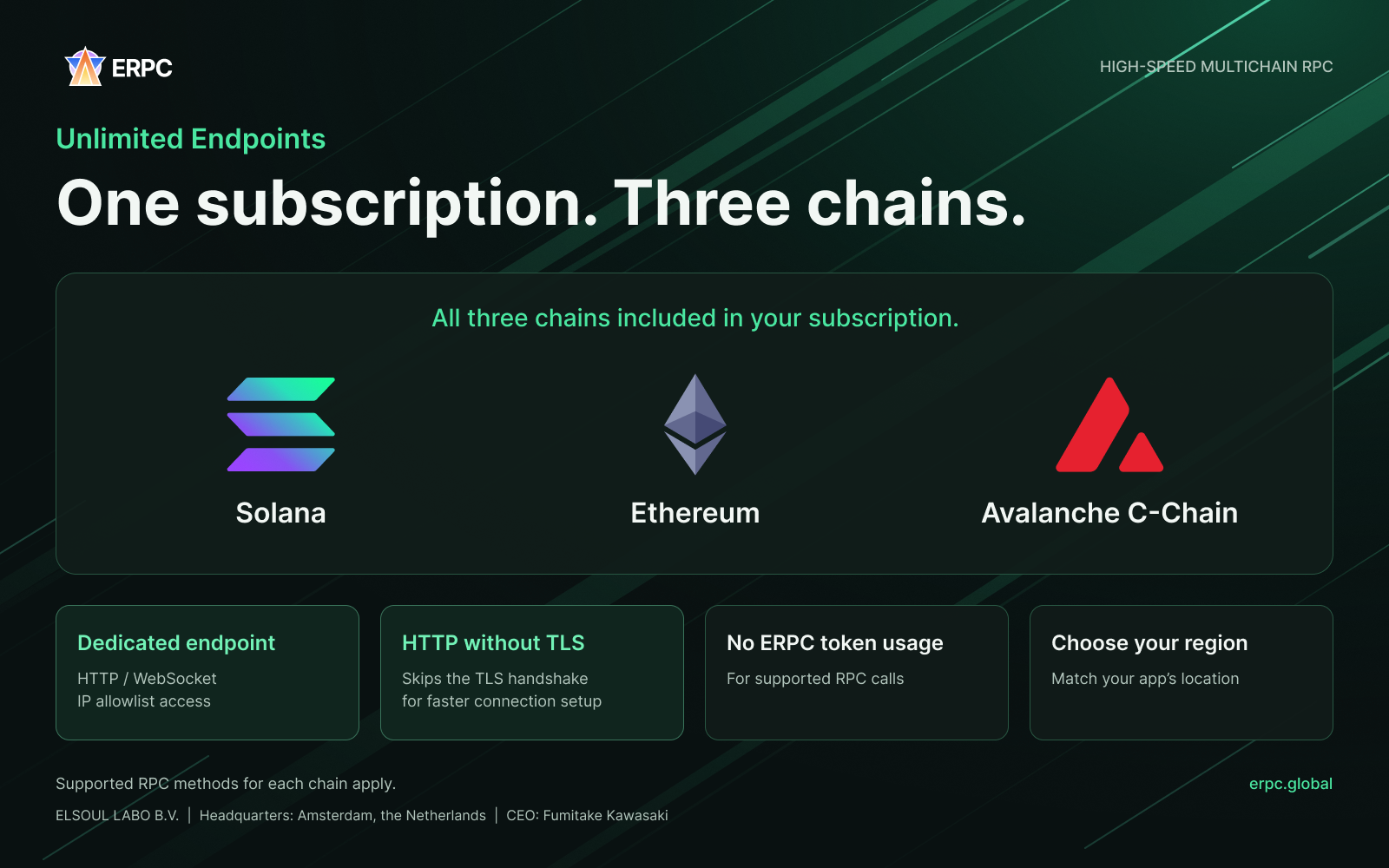
All three chains are included in the price of one Unlimited subscription. A developer adding Ethereum or Avalanche C-Chain state queries to a Solana trading application, or building a backend for multiple chains, does not need a separate Unlimited subscription for each chain. Subscription management stays together as connections are added, and supported RPC calls do not incur additional ERPC token consumption.
The URL path on the dedicated endpoint selects the chain.
| Chain | HTTP RPC connection |
|---|---|
| Solana | Use the supplied endpoint URL as provided |
| Ethereum | Append /eth to the endpoint URL |
| Avalanche C-Chain | Append /ava to the endpoint URL |
WebSocket is also available, using
/eth/ws for Ethereum and /ava/ws for Avalanche C-Chain. Connection URLs are available in the dashboard.Optimize connections with region selection and HTTP
Being able to select the endpoint region lets developers consider a connection close to where their trading system or backend runs. For latency-sensitive workloads, it is important to consider server and RPC placement together and check the actual network path and response times.
HTTP connections operate without TLS, avoiding a TLS handshake when establishing a connection. WebSocket is available on the same port as HTTP. HTTPS is not supported, so use an environment that can connect over HTTP and use an IP allowlist.
Here, dedicated refers to the endpoint. Actual response times and throughput depend on application placement and request contents, so measuring your usual workload helps establish whether the service fits your use case.
Pricing and hourly billing: test in your own environment
The listed prices as of November 5, 2026 are:
| Plan | Monthly price | Hourly billing |
|---|---|---|
| Unlimited (Standard) | €298/month | €0.52/hour |
| Unlimited Pro | €498/month | €0.86/hour |
Start with Standard, and consider scaling up to Pro if you begin to encounter processing bottlenecks.
Hourly billing is in one-hour units and starts when each instance begins running. Unused minutes are not refunded. You can first run your usual requests with hourly billing, check response times and errors, and then compare the monthly plan based on how long you expect to use the service.
Having three chains in one subscription and no ERPC token consumption for supported RPC calls are advantages when planning the cost of multichain or high-frequency access. Check the latest prices, available regions and stock in the dashboard when ordering.
Get started from the dashboard
- Select Choose a plan on the dashboard's Unlimited Endpoints page.
- Select a plan, monthly or hourly billing, and a region suited to where your application runs. Check the price and stock before ordering.
- Once the endpoint is ready, register the IP address of the server that will connect and configure the supplied HTTP or WebSocket URL in your application. Authentication uses an IP allowlist instead of an API key.
- Test your usual workload. To finish an hourly-billed test, use the menu for the relevant endpoint to end usage and confirm that billing has stopped.
Choose and try Unlimited Endpoints
https://dashboard.erpc.global/en/user/unlimited
Compare prices and plans
https://erpc.global/en/price/
Unlimited Endpoint Supported Methods
https://erpc.global/en/doc/rpc/unlimited-endpoint-supported-methods/
ERPC and future chain support
Following the addition of Ethereum and Avalanche C-Chain, ERPC will continue expanding the chains supported by Unlimited Endpoints. The goal is to let developers who have used the service for high-speed Solana RPC access make use of it across more chains.
ERPC is a global blockchain infrastructure platform operated by ELSOUL LABO B.V. It provides RPC and data-streaming services, bare-metal servers, VPS and open-source developer tools, helping developers and businesses build infrastructure suited to their use cases.
ERPC Official Website
https://erpc.global/en/