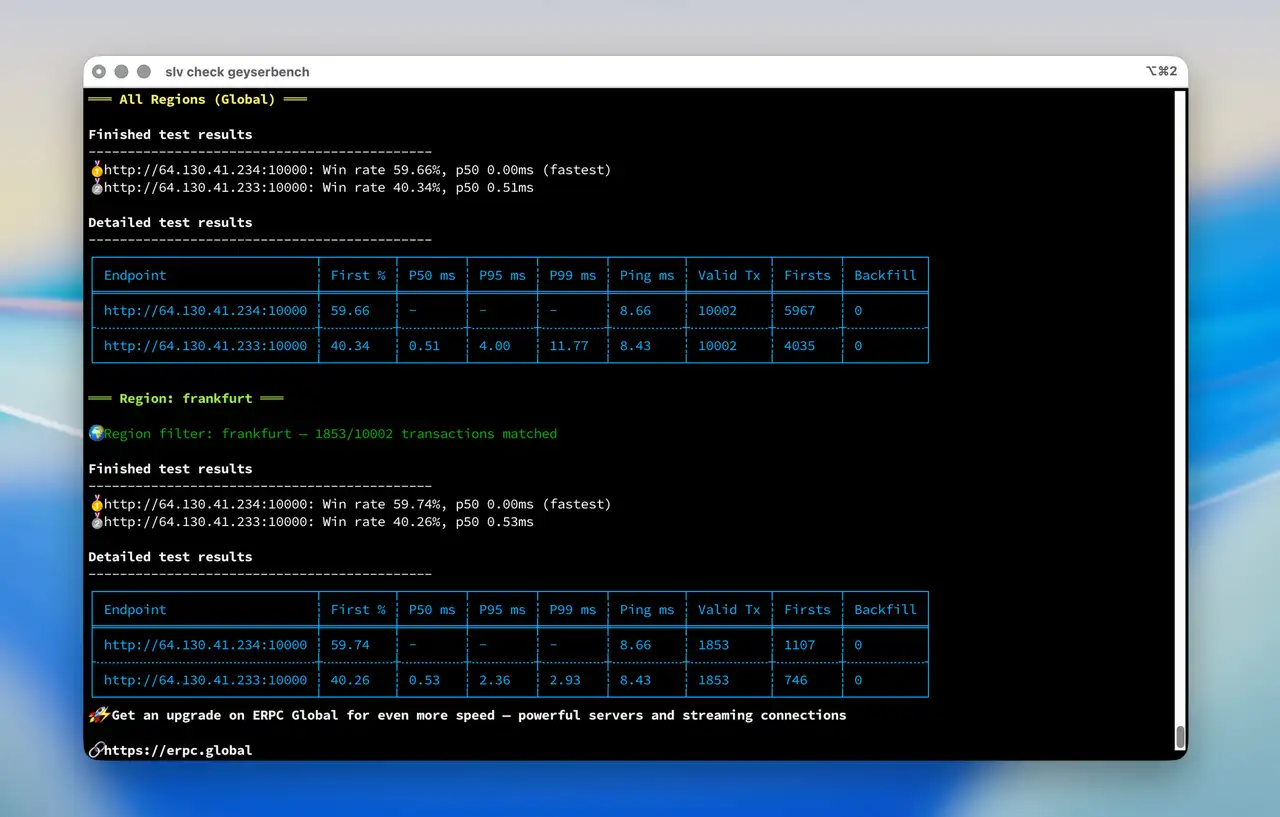
slv check geyserbench is a Solana benchmark command for comparing Shredstream, gRPC, and RPC performance. Choose the connection kind, enter the endpoints you want to compare, and the CLI will show win rate, p50, p95, p99, ping, firsts, and backfill in one report.
Install first
curl -fsSL https://storage.slv.dev/slv/install | sh
curl -fsSL https://storage.slv.dev/slv/install | sh
You can use the command immediately after installation.
Basic usage
slv check geyserbench --help
Usage:   slv check geyserbench
Version: 2026.4.3.1321

Description:

  Run geyserbench with generated config

Options:

  -h, --help                      - Show this help.
  --kind          <kind>          - Benchmark kind: shredstream | grpc | rpc
  --region        <region>        - Benchmark region for region-aware measurement
  --endpoint      <endpoint>      - Endpoint URL to compare
  --transactions  <transactions>  - Transaction sample size                        (Default: 10000)
Interactive mode is straightforward:
slv check geyserbench
? Benchmark kind (shredstream / grpc / rpc): (shredstream) ›
? Region (--region) for accurate measurement: (frankfurt) ›
? First endpoint URL: ›
slv check geyserbench
? Benchmark kind (shredstream / grpc / rpc): (shredstream) ›
? Region (--region) for accurate measurement: (frankfurt) ›
? First endpoint URL: ›
Pick the transport first, choose the region, and then enter the endpoints you want to compare.
Why region-aware measurement matters
Solana is global, and leaders rotate while blocks are produced. Because data propagation speed depends on how close you are to the current leader, regions closer to leader slots can receive data faster. That means region-by-region comparison gives a more accurate view than looking only at global averages.
This is especially useful for global apps and for very low-latency workloads such as high-frequency trading, where saving even 1 ms matters.